Economy of Mergania
Some intro text here ...
History
This section about the history of the Mergan Economy is a blind text and will be expanded hopefully soon. Similar blind texts will be edited and expanded by the corresponding territory's owner. If you have any ideas about it, feel free to participate and edit this section. However, please respect other people's previous work – if you want to change already-developed ideas, contact the author. A stub is an article that, although sometimes providing more or less useful information, is too short to provide OGF encyclopedic coverage of a subject, and that is capable of expansion. Also non-article pages, such as disambiguation pages, lists, categories, templates, talk pages, and redirects, can be regarded as stubs. Due to the lack of time, some stub articles have little verifiable information, but its subject has an apparent notability. Stub articles and sections are very important to the life of a wiki. Adding a topic might inspire another community member to add to it, and eventually the topic has enough content to be valuable to the community. Stub pages help show the progressive nature of the wiki. Sizable articles are usually not considered stubs, even if they have significant problems or are noticeably incomplete. Over the years, different editors have followed different rules of thumb to help them decide when an article is likely to be a stub. Editors may decide that an article with more than ten sentences is too big to be a stub, or that the threshold for another article may be 250 words. Others follow other standards of e.g. 1500 characters in the main text. There is no set size at which an article stops being a stub. While very short articles are very likely to be stubs, there are some subjects about which very little can be written. Conversely, there are subjects about which a lot could be written, and their articles may still be stubs even if they are a few paragraphs long. As such, it is impossible to state whether an article is a stub based solely on its length, and any decision on the article has to come down to an editor's best judgement (the user essay on the Croughton-London rule may be of use when trying to judge whether an article is a stub). Similarly, stub status usually depends on the length of prose text alone – lists, templates, images, and other such peripheral parts of an article are usually not considered when judging whether an article is a stub. So let me conclude, this section will be expanded soon.
Sectors
This section about sectors is a blind text and will be expanded hopefully soon. Similar blind texts will be edited and expanded by the corresponding territory's owner. If you have any ideas about it, feel free to participate and edit this section. However, please respect other people's previous work – if you want to change already-developed ideas, contact the author. A stub is an article that, although sometimes providing more or less useful information, is too short to provide OGF encyclopedic coverage of a subject, and that is capable of expansion. Also non-article pages, such as disambiguation pages, lists, categories, templates, talk pages, and redirects, can be regarded as stubs. Due to the lack of time, some stub articles have little verifiable information, but its subject has an apparent notability. Stub articles and sections are very important to the life of a wiki. Adding a topic might inspire another community member to add to it, and eventually the topic has enough content to be valuable to the community. Stub pages help show the progressive nature of the wiki. Sizable articles are usually not considered stubs, even if they have significant problems or are noticeably incomplete. Over the years, different editors have followed different rules of thumb to help them decide when an article is likely to be a stub.
Primary
This section about the primary sector is a blind text and will be expanded hopefully soon. Similar blind texts will be edited and expanded by the corresponding territory's owner. If you have any ideas about it, feel free to participate and edit this section. However, please respect other people's previous work – if you want to change already-developed ideas, contact the author. A stub is an article that, although sometimes providing more or less useful information, is too short to provide OGF encyclopedic coverage of a subject, and that is capable of expansion. Also non-article pages, such as disambiguation pages, lists, categories, templates, talk pages, and redirects, can be regarded as stubs. Due to the lack of time, some stub articles have little verifiable information, but its subject has an apparent notability. Stub articles and sections are very important to the life of a wiki.
Industry
This section about industry is a blind text and will be expanded hopefully soon. Similar blind texts will be edited and expanded by the corresponding territory's owner. If you have any ideas about it, feel free to participate and edit this section. However, please respect other people's previous work – if you want to change already-developed ideas, contact the author. A stub is an article that, although sometimes providing more or less useful information, is too short to provide OGF encyclopedic coverage of a subject, and that is capable of expansion. Also non-article pages, such as disambiguation pages, lists, categories, templates, talk pages, and redirects, can be regarded as stubs. Due to the lack of time, some stub articles have little verifiable information, but its subject has an apparent notability. Stub articles and sections are very important to the life of a wiki. Adding a topic might inspire another community member to add to it, and eventually the topic has enough content to be valuable to the community. Stub pages help show the progressive nature of the wiki. Sizable articles are usually not considered stubs, even if they have significant problems or are noticeably incomplete. Over the years, different editors have followed different rules of thumb to help them decide when an article is likely to be a stub. Editors may decide that an article with more than ten sentences is too big to be a stub, or that the threshold for another article may be 250 words. Others follow other standards of e.g. 1500 characters in the main text. There is no set size at which an article stops being a stub. While very short articles are very likely to be stubs, there are some subjects about which very little can be written. Conversely, there are subjects about which a lot could be written, and their articles may still be stubs even if they are a few paragraphs long. Holswig Brauerei Thüssing & Fehrenbach Fahrzeugtechnik Wenkel
Services
This section about services is a blind text and will be expanded hopefully soon. Similar blind texts will be edited and expanded by the corresponding territory's owner. If you have any ideas about it, feel free to participate and edit this section. However, please respect other people's previous work – if you want to change already-developed ideas, contact the author. A stub is an article that, although sometimes providing more or less useful information, is too short to provide OGF encyclopedic coverage of a subject, and that is capable of expansion. Gobeletplain Mergaveer
Infrastructure
This section about infrastructure is a blind text and will be expanded hopefully soon. Similar blind texts will be edited and expanded by the corresponding territory's owner. If you have any ideas about it, feel free to participate and edit this section.
Transport
This section about transport is a blind text and will be expanded hopefully soon. Similar blind texts will be edited and expanded by the corresponding territory's owner. If you have any ideas about it, feel free to participate and edit this section. However, please respect other people's previous work – if you want to change already-developed ideas, contact the author. A stub is an article that, although sometimes providing more or less useful information, is too short to provide OGF encyclopedic coverage of a subject, and that is capable of expansion. Also non-article pages, such as disambiguation pages, lists, categories, templates, talk pages, and redirects, can be regarded as stubs. Due to the lack of time, some stub articles have little verifiable information, but its subject has an apparent notability. Stub articles and sections are very important to the life of a wiki. Adding a topic might inspire another community member to add to it, and eventually the topic has enough content to be valuable to the community. Stub pages help show the progressive nature of the wiki. Sizable articles are usually not considered stubs, even if they have significant problems or are noticeably incomplete. Over the years, different editors have followed different rules of thumb to help them decide when an article is likely to be a stub. Editors may decide that an article with more than ten sentences is too big to be a stub, or that the threshold for another article may be 250 words. Others follow other standards of e.g. 1500 characters in the main text. There is no set size at which an article stops being a stub. While very short articles are very likely to be stubs, there are some subjects about which very little can be written. Conversely, there are subjects about which a lot could be written, and their articles may still be stubs even if they are a few paragraphs long. As such, it is impossible to state whether an article is a stub based solely on its length, and any decision on the article has to come down to an editor's best judgement (the user essay on the Croughton-London rule may be of use when trying to judge whether an article is a stub). Similarly, stub status usually depends on the length of prose text alone – lists, templates, images, and other such peripheral parts of an article are usually not considered when judging whether an article is a stub. So let me conclude, this section will be expanded soon.
Healthcare
This section about healthcare is a blind text and will be expanded hopefully soon. Similar blind texts will be edited and expanded by the corresponding territory's owner. If you have any ideas about it, feel free to participate and edit this section. However, please respect other people's previous work – if you want to change already-developed ideas, contact the author. A stub is an article that, although sometimes providing more or less useful information, is too short to provide OGF encyclopedic coverage of a subject, and that is capable of expansion. Also non-article pages, such as disambiguation pages, lists, categories, templates, talk pages, and redirects, can be regarded as stubs. Due to the lack of time, some stub articles have little verifiable information, but its subject has an apparent notability.
Energy
This section about energy is a blind text and will be expanded hopefully soon. Similar blind texts will be edited and expanded by the corresponding territory's owner. If you have any ideas about it, feel free to participate and edit this section. However, please respect other people's previous work – if you want to change already-developed ideas, contact the author. A stub is an article that, although sometimes providing more or less useful information, is too short to provide OGF encyclopedic coverage of a subject, and that is capable of expansion. Also non-article pages, such as disambiguation pages, lists, categories, templates, talk pages, and redirects, can be regarded as stubs. Due to the lack of time, some stub articles have little verifiable information, but its subject has an apparent notability. Stub articles and sections are very important to the life of a wiki. Adding a topic might inspire another community member to add to it, and eventually the topic has enough content to be valuable to the community. Stub pages help show the progressive nature of the wiki. Sizable articles are usually not considered stubs, even if they have significant problems or are noticeably incomplete. Over the years, different editors have followed different rules of thumb to help them decide when an article is likely to be a stub.
Technology
This section about technology is a blind text and will be expanded hopefully soon. Similar blind texts will be edited and expanded by the corresponding territory's owner. If you have any ideas about it, feel free to participate and edit this section. However, please respect other people's previous work – if you want to change already-developed ideas, contact the author. A stub is an article that, although sometimes providing more or less useful information, is too short to provide OGF encyclopedic coverage of a subject, and that is capable of expansion. Also non-article pages, such as disambiguation pages, lists, categories, templates, talk pages, and redirects, can be regarded as stubs. Due to the lack of time, some stub articles have little verifiable information, but its subject has an apparent notability. Stub articles and sections are very important to the life of a wiki.
Innovations
Due to its economic prosperity in the East Ulethan region, Mergania became known for many innovation, especially in the early days of industrialization. The most remarkable ones are mentioned here (in alphabetic order):
- Karl Auwart (*1935, †2012) was an engineer at Oreon and designed the first low-floor bus in 1971.
- a
- a
- a
- a
- Albrecht Brohl (*1901, †1984) constructed the first bus with self-supporting body in 1949, instead of using a separate chassis and body. This concept now features in most modern buses and coaches.
- b
- b
- b
- b
- c
- c
- c
- d
- d
- d
- e
- e
- e
- francis (*0000 in Darcodia, †0000), water turbine'
- f
- f
- g
- g
- g
- h
- h
- h
- i
- i
- i
- j
- j
- j
- kaplan (*0000, †0000) water turbine
- k
- k
- Wilhelm Lindenthal (*1848, †1899) was a Mergan aviation pioneer. By making well-documented, repeated, successful flights with gliders, he developed the concept of the modern wing and produced the first airplanes "heavier than air".
- l
- l
- Peter Malkom (*1899, †1988) was a Mergan transport entrepreneur. In 1931, he developed the concept of the modern intermodal shipping container after buying his first truck. Malkom emigrated to Paroy in 1937, from where his invention became an international standard and led to the cargo unit Paroyan proportionate entity. The shipping container led to a significant reduction in the cost of freight transportation and also improved reliability. Thus it revolutionized transport and international trade in the second half of the twentieth century.
- Mattheussen (*0000, †0000): paper machine
- m
- m
- n
- n
- n
- o
- o
- o
- Felix Paschke (*1914, †1993) designed the Paschke rotary engine, which is a type of internal combustion engine using an eccentric rotary design to convert pressure into rotating motion.
- pelton (*0000 in Antaraxia, †0000), water turbine
- p
- p
- Christoph von Reithmann (*1822, †1902) was a highly respected watchmaker. He invented the four-stroke engine in 1863 and produced engines, before his Reithmann Motoren Gesellschaft was merged with Aubach in 1879.
- r
- August Schagendorff (*1858, †1943) designed a fully automatic railway coupling in 1905. Known as Schagendorff coupler (Mergan: Schagendorffkupplung, abbreviated Schaku), it is superior due to the automatic pneumatic and electrical connections and disconnections and is used nowadays by many railways worldwide.
- s
- s
- s
- s
- s
- t
- t
- u
- u
- v
- v
- w
- w
- z
- z
Notable companies
The following sections list in alphabetic order Mergan-based companies of remarkable size as well as international operating companies with notable branches in Mergania.
Aerotheon Group
Some text ...
Some details ...
AlphaStore
Some text ...
Some details ...
Ampera
Some text ...
Some details ...
Aubach
Aubach is a Mergan multi national automotive corporation headquartered in xxxx, Schersen. It is the second largest automaker in Mergania and one of the world's leading car manufacturers. The company was founded in 1822 and first produced horse-drawn vehicles. After the merger with the Reithmann Motoren Gesellschaft in 1879 it started to produce vehicles with combustion engines and has grown rapidly.
Some details ...
Batag (Brugham-Arkanta Transport-Actien-Gesellschaft)
Some text ...
Some details ...
Elektra
Some text ...
Some details ...
Gobeletplain
Gobeletplain is a worldwide operating coffee company and coffeehouse chain. Gobeletplain was founded in Freistat, Mergania in 1923. All company's locations serve hot and cold drinks, whole-bean coffee, caffe latte, espresso, different types of tea, juices and snacks including items such as chips and crackers. Many stores sell pre-packaged food items, hot and cold sandwiches, and drinkware including tumblers and mugs.
History
The first Gobeletplain café was opened in May 1923 at St. Gobeletplain in Stanncatt by the master confectioner Herbert Schultheißer.
Logo from 1982-1997
Logo from 1923-1982
current logo
Gobeletplain ad.png
List of stores
2.1 Domestic stores 2.2 International stores 2.3 Stores in the Federal States 2.4 Show stores on map
Heisse
This section about Planeo is a blind text and will be expanded hopefully soon. Similar blind texts will be edited and expanded by the corresponding territory's owner. If you have any ideas about it, feel free to participate and edit this section. However, please respect other people's previous work – if you want to change already-developed ideas, contact the author. A stub is an article that, although sometimes providing more or less useful information, is too short to provide OGF encyclopedic coverage of a subject, and that is capable of expansion.
This section is a blind text and will be expanded hopefully soon. Similar blind texts will be edited and expanded by the corresponding territory's owner. If you have any ideas about it, feel free to participate and edit this section. However, please respect other people's previous work – if you want to change already-developed ideas, contact the author. A stub is an article that, although sometimes providing more or less useful information, is too short to provide OGF encyclopedic coverage of a subject, and that is capable of expansion. Also non-article pages, such as disambiguation pages, lists, categories, templates, talk pages, and redirects, can be regarded as stubs. Due to the lack of time, some stub articles have little verifiable information, but its subject has an apparent notability. Stub articles and sections are very important to the life of a wiki. Adding a topic might inspire another community member to add to it, and eventually the topic has enough content to be valuable to the community. Stub pages help show the progressive nature of the wiki. Sizable articles are usually not considered stubs, even if they have significant problems or are noticeably incomplete. Over the years, different editors have followed different rules of thumb to help them decide when an article is likely to be a stub. Editors may decide that an article with more than ten sentences is too big to be a stub, or that the threshold for another article may be 250 words. Others follow other standards of e.g. 1500 characters in the main text. There is no set size at which an article stops being a stub. While very short articles are very likely to be stubs, there are some subjects about which very little can be written. Conversely, there are subjects about which a lot could be written, and their articles may still be stubs even if they are a few paragraphs long. As such, it is impossible to state whether an article is a stub based solely on its length, and any decision on the article has to come down to an editor's best judgement (the user essay on the Croughton-London rule may be of use when trying to judge whether an article is a stub). Similarly, stub status usually depends on the length of prose text alone – lists, templates, images, and other such peripheral parts of an article are usually not considered when judging whether an article is a stub. So let me conclude, this section will be expanded soon.
Mergaveer
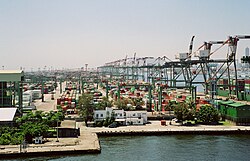

The Mergaveer Corporation, headquartered in Brugham, Mergany is a global freight shipping company. Its principal trading routes are the Eastern Uletha to Antarephia, the Eastern Uletha to Archanta and in the Darcodian Sea and Kaspen Sea. Mergaveer's shipping containers are painted green with the word "MERGAVEER" placed on the sides in white letters. Main harbour with service and maintenance facilities is the Port of Brugham. Other large hubs are Khaiwoon, Trevers, Merania and Norderhaven.


Fleet

Mergaveer currently operates about 190 ships, 161 of which are container ships with a total fleet capacity of 0.8 million PPE. Here is a list of the largest ones:
- MERG-J2-class, 3 ships, around 11000 PPE, built since 2016 by Holm&Voss
- MERG-J-class, 15 ships, around 9000 PPE, built since 2012 by Holm&Voss
- MERG-H-class, 11 ships, around 7500 PPE, built 2009-2012
- MERG-G-class, 33 ships, around 6150 PPE, built 2002-2009
- MERG-F-class, 28 ships, around 5050 PPE, built 1998-2002
- MERG-E-class, 29 ships, around 4250 PPE, built 1992-1998
- MERG-D-class, 16 ships, around 3500 PPE, built 1988-1992
- MERG-C-class, 8 ships, around 3100 PPE, built 1987-1988
- MERG-B-class, 10 ships, around 2100 PPE, built 1984-1986
- MERG-A3-class, 9 ships, around 1150 PPE, built 1983-1984 (6 in operation)
- MERG-A2-class, 17 ships, around 1050 PPE, built 1979-1983 (5 in operation)
- MERG-A-class, 3 ships, around 950 PPE, built 1978 (all are retired or sold)
- Colong's class, 7 ships, around 800 PPE, built 1974-1977 (all are retired or sold)
- Cooke's class, 12 ships, around 650 PPE, built 1969-1975 (all are retired or sold)
- Simi's class, 6 ships, around 370 PPE, built 1965-1971 (all are retired or sold)

Main ports
- Brugham
- Norderhaven
- Khaiwooon, Khaiwooon
- xxx, Latina
- Trevers, Paroy
Frequent shipping routes
- Khaiwoon---Brugham
- xxx---Brugham
- xxx---Brugham
- xxx---Brugham
- xxx---Brugham
- xxx---Brugham
- xxx---Brugham
Oreon
Oreon is a Mergan automotive company that manufactures buses, trolleybuses and coaches. Founded by Ernst Gottwaldt in 1936, it presented the first bus with self-supporting body in 1949. This technical innovation, mainly pushed by the engineer Albrecht Brohl, became a standard concept in most modern buses and coaches. Later on the company became recognized for their low-floor buses, comfortable coaches and high-capacity airport buses.
The company was founded by Gottlob Auwärter in Stuttgart in 1935, and manufactured bodywork for bus and truck chassis. By 1953, the company had moved away from manufacturing buses on truck chassis, to a partial monocoque design with a steel tube skeleton, providing the structural support, enhanced by welded side panels.[5][6] The engine was moved to the rear. In 1957, air suspension was made available. 1960s In 1961, a new bus design, the Typ Hamburg, was unveiled at the Geneva Motor Show. Developed by the founder's eldest son, Albrecht Auwärter, and another student, Swiss national Bob Lee, as part of their dissertation at Hamburg University. The design was the first bus to allow passengers to regulate their fresh air supply through a nozzle from two air ducts, commonly seen in contemporary designs, as well as offering air suspension.[7][8] Both Albrecht and Lee joined Neoplan after graduating from the university. Albrecht took over management of the company in 1965, and Bob Lee later became head of Engineering and Design. In 1964, the founder's second son, Konrad Auwärter, developed a double-deck bus design for a service bus as part of his dissertation.[7] The "Do-Bus" design had low weight, and could carry over 100 passengers. It also featured a low-frame front axle with forward-mounted steering gear that permitted a low, flat floor. The double-deck principle was applied to the coach design, creating a high-capacity comfortable touring vehicle. This vehicle was known as the Skyliner.
The first Setra coach, the Type S 8, so called because it contained eight rows of seats, was introduced in April 1951 at the German Internationale Automobil-Ausstellung. It featured a self-supporting body designed by Otto Kässbohrer, a concept now featured in most modern coaches and buses. Equally unusual at the time was the decision to locate the engine behind the rear axle; the rear-mounted engine configuration is another Kässbohrer-Setra innovation which subsequently became mainstream. It simplified the production process and created a range of passenger-focused possibilities regarding the floor level in the passenger and driver/crew sections, and for high-floor layouts, flexible use of the underfloor area.
Setra[1] is a German bus brand of EvoBus GmbH, itself a wholly owned subsidiary of Daimler Truck AG. The name "Setra" comes from "selbsttragend" (self-supporting). This refers to the integral nature of the construction of the vehicles back in the 1950s when competitor vehicles still featured a separate chassis and body (often manufactured by separate companies). It is also possible that, with an eye to export markets, the company was mindful that for non-German speakers, the name "Kässbohrer" is difficult to pronounce. Until 1995 the firm operated under the name Karl Kässbohrer Fahrzeugwerke GmbH, but in that year economic difficulties enforced its sale to Daimler-Benz AG (between 1998 and 2008 known, especially in the United States, by the name of its holding company Daimler Chrysler). Since 1995,[2] Setra has been a brand of the Daimler subsidiary, EvoBus GmbH. The North American distribution for Setra by Daimler was set to be partnered and taken over by Motor Coach Industries on April 25, 2012, as Daimler restructured its North American bus operations in 2013;[3] this agreement lasted until the end of 2017 when the REV Group assumed distribution responsibilities. Daimler has again self-distributed Setra coaches in North America since January 2020, through its new subsidiary, Daimler Coaches North America, LLC, with service support from Daimler Truck North America.
Patrans
Pxxxxxxx Aubach Transportation, commonly known under its brand PATrans, is a multi national rail transportation equipment manufacturer with facilities concentrated in Eastern Uletha and Archanta. The company was created in 1982 in the merger of Pxxxxxxxx with Aubach 's rail equipment manufacturing facilities. Patrans manufactures mainline locomotives, high-speed and regional trains, metro and underground passenger trains, trams and people movers as well as freight wagons. Non rolling stock businesses included railway electrification and signalling infrastructure.
Some details ...
Schmidtler Rail
Schmidtler Rail is a Mergan manufacturer of railway rolling stock headquartered in xxxxxxxxxx. The company is focused on regional trains, especially multiple units and trams, and produces niche products, such as track maintenance trains and equipment.
History
Current products
Wagen Union
The Wagen Union is a Mergan multi national automotive corporation headquartered in xxxx, Schersen. It is the largest automaker in Mergania and one of the world's leading car manufacturers. Founded in 1932, it was able to produce a remarkable large number of cars.
Some details ...
Wātānābe Ärospás
Wātānābe Ärospás (SC)
Some details ...
xxxxxxxxxxxxxxxxxx
This section about xxxxxxxxxxxxxxxxx is a blind text and will be expanded hopefully soon. Similar blind texts will be edited and expanded by the corresponding territory's owner. If you have any ideas about it, feel free to participate and edit this section.
This section is a blind text and will be expanded hopefully soon. Similar blind texts will be edited and expanded by the corresponding territory's owner. If you have any ideas about it, feel free to participate and edit this section. However, please respect other people's previous work – if you want to change already-developed ideas, contact the author. A stub is an article that, although sometimes providing more or less useful information, is too short to provide OGF encyclopedic coverage of a subject, and that is capable of expansion. Also non-article pages, such as disambiguation pages, lists, categories, templates, talk pages, and redirects, can be regarded as stubs. Due to the lack of time, some stub articles have little verifiable information, but its subject has an apparent notability. Stub articles and sections are very important to the life of a wiki. Adding a topic might inspire another community member to add to it, and eventually the topic has enough content to be valuable to the community. Stub pages help show the progressive nature of the wiki. Sizable articles are usually not considered stubs, even if they have significant problems or are noticeably incomplete. Over the years, different editors have followed different rules of thumb to help them decide when an article is likely to be a stub. Editors may decide that an article with more than ten sentences is too big to be a stub, or that the threshold for another article may be 250 words. Others follow other standards of e.g. 1500 characters in the main text. There is no set size at which an article stops being a stub.
Further companies
The following section list in alphabetic order further Mergan-based companies.
Primary sector
Some text ...
Some details ...
Secondary sector
Some text ...
Some details ...
Tertiary sector
Some text ...
Some details ...