Difference between revisions of "Economy of Mergania"
m (→Companies) |
m (→Infrastructure) |
||
| Line 23: | Line 23: | ||
==Infrastructure== | ==Infrastructure== | ||
| − | {{Blind text|topic= | + | {{Blind text|topic=Infrastructure|length=3}} |
===Transport=== | ===Transport=== | ||
| − | {{Blind text|topic= | + | {{Blind text|topic=Transport|length=20}} |
| + | |||
| + | ===Healthcare=== | ||
| + | {{Blind text|topic=Healthcare|length=7}} | ||
===Energy=== | ===Energy=== | ||
| − | {{Blind text|topic= | + | {{Blind text|topic=Energy|length=12}} |
==Technology== | ==Technology== | ||
Revision as of 03:55, 30 July 2022
Some intro text here ...
History
This section about the history of the Mergan Economy is a blind text and will be expanded hopefully soon. Similar blind texts will be edited and expanded by the corresponding territory's owner. If you have any ideas about it, feel free to participate and edit this section. However, please respect other people's previous work – if you want to change already-developed ideas, contact the author. A stub is an article that, although sometimes providing more or less useful information, is too short to provide OGF encyclopedic coverage of a subject, and that is capable of expansion. Also non-article pages, such as disambiguation pages, lists, categories, templates, talk pages, and redirects, can be regarded as stubs. Due to the lack of time, some stub articles have little verifiable information, but its subject has an apparent notability. Stub articles and sections are very important to the life of a wiki. Adding a topic might inspire another community member to add to it, and eventually the topic has enough content to be valuable to the community. Stub pages help show the progressive nature of the wiki. Sizable articles are usually not considered stubs, even if they have significant problems or are noticeably incomplete. Over the years, different editors have followed different rules of thumb to help them decide when an article is likely to be a stub. Editors may decide that an article with more than ten sentences is too big to be a stub, or that the threshold for another article may be 250 words. Others follow other standards of e.g. 1500 characters in the main text. There is no set size at which an article stops being a stub. While very short articles are very likely to be stubs, there are some subjects about which very little can be written. Conversely, there are subjects about which a lot could be written, and their articles may still be stubs even if they are a few paragraphs long. As such, it is impossible to state whether an article is a stub based solely on its length, and any decision on the article has to come down to an editor's best judgement (the user essay on the Croughton-London rule may be of use when trying to judge whether an article is a stub). Similarly, stub status usually depends on the length of prose text alone – lists, templates, images, and other such peripheral parts of an article are usually not considered when judging whether an article is a stub. So let me conclude, this section will be expanded soon.
Sectors
This section about the history of the Mergan Economy is a blind text and will be expanded hopefully soon. Similar blind texts will be edited and expanded by the corresponding territory's owner. If you have any ideas about it, feel free to participate and edit this section. However, please respect other people's previous work – if you want to change already-developed ideas, contact the author. A stub is an article that, although sometimes providing more or less useful information, is too short to provide OGF encyclopedic coverage of a subject, and that is capable of expansion. Also non-article pages, such as disambiguation pages, lists, categories, templates, talk pages, and redirects, can be regarded as stubs. Due to the lack of time, some stub articles have little verifiable information, but its subject has an apparent notability. Stub articles and sections are very important to the life of a wiki. Adding a topic might inspire another community member to add to it, and eventually the topic has enough content to be valuable to the community. Stub pages help show the progressive nature of the wiki. Sizable articles are usually not considered stubs, even if they have significant problems or are noticeably incomplete. Over the years, different editors have followed different rules of thumb to help them decide when an article is likely to be a stub.
Primary
This section about the history of the Mergan Economy is a blind text and will be expanded hopefully soon. Similar blind texts will be edited and expanded by the corresponding territory's owner. If you have any ideas about it, feel free to participate and edit this section. However, please respect other people's previous work – if you want to change already-developed ideas, contact the author. A stub is an article that, although sometimes providing more or less useful information, is too short to provide OGF encyclopedic coverage of a subject, and that is capable of expansion. Also non-article pages, such as disambiguation pages, lists, categories, templates, talk pages, and redirects, can be regarded as stubs. Due to the lack of time, some stub articles have little verifiable information, but its subject has an apparent notability. Stub articles and sections are very important to the life of a wiki.
Industry
This section about the history of the Mergan Economy is a blind text and will be expanded hopefully soon. Similar blind texts will be edited and expanded by the corresponding territory's owner. If you have any ideas about it, feel free to participate and edit this section. However, please respect other people's previous work – if you want to change already-developed ideas, contact the author. A stub is an article that, although sometimes providing more or less useful information, is too short to provide OGF encyclopedic coverage of a subject, and that is capable of expansion. Also non-article pages, such as disambiguation pages, lists, categories, templates, talk pages, and redirects, can be regarded as stubs. Due to the lack of time, some stub articles have little verifiable information, but its subject has an apparent notability. Stub articles and sections are very important to the life of a wiki. Adding a topic might inspire another community member to add to it, and eventually the topic has enough content to be valuable to the community. Stub pages help show the progressive nature of the wiki. Sizable articles are usually not considered stubs, even if they have significant problems or are noticeably incomplete. Over the years, different editors have followed different rules of thumb to help them decide when an article is likely to be a stub. Editors may decide that an article with more than ten sentences is too big to be a stub, or that the threshold for another article may be 250 words. Others follow other standards of e.g. 1500 characters in the main text. There is no set size at which an article stops being a stub. While very short articles are very likely to be stubs, there are some subjects about which very little can be written. Conversely, there are subjects about which a lot could be written, and their articles may still be stubs even if they are a few paragraphs long. Holswig Brauerei Thüssing & Fehrenbach Fahrzeugtechnik Wenkel
Services
This section about the history of the Mergan Economy is a blind text and will be expanded hopefully soon. Similar blind texts will be edited and expanded by the corresponding territory's owner. If you have any ideas about it, feel free to participate and edit this section. However, please respect other people's previous work – if you want to change already-developed ideas, contact the author. A stub is an article that, although sometimes providing more or less useful information, is too short to provide OGF encyclopedic coverage of a subject, and that is capable of expansion. Gobeletplain Mergaveer
Infrastructure
This section about Infrastructure is a blind text and will be expanded hopefully soon. Similar blind texts will be edited and expanded by the corresponding territory's owner. If you have any ideas about it, feel free to participate and edit this section.
Transport
This section about Transport is a blind text and will be expanded hopefully soon. Similar blind texts will be edited and expanded by the corresponding territory's owner. If you have any ideas about it, feel free to participate and edit this section. However, please respect other people's previous work – if you want to change already-developed ideas, contact the author. A stub is an article that, although sometimes providing more or less useful information, is too short to provide OGF encyclopedic coverage of a subject, and that is capable of expansion. Also non-article pages, such as disambiguation pages, lists, categories, templates, talk pages, and redirects, can be regarded as stubs. Due to the lack of time, some stub articles have little verifiable information, but its subject has an apparent notability. Stub articles and sections are very important to the life of a wiki. Adding a topic might inspire another community member to add to it, and eventually the topic has enough content to be valuable to the community. Stub pages help show the progressive nature of the wiki. Sizable articles are usually not considered stubs, even if they have significant problems or are noticeably incomplete. Over the years, different editors have followed different rules of thumb to help them decide when an article is likely to be a stub. Editors may decide that an article with more than ten sentences is too big to be a stub, or that the threshold for another article may be 250 words. Others follow other standards of e.g. 1500 characters in the main text. There is no set size at which an article stops being a stub. While very short articles are very likely to be stubs, there are some subjects about which very little can be written. Conversely, there are subjects about which a lot could be written, and their articles may still be stubs even if they are a few paragraphs long. As such, it is impossible to state whether an article is a stub based solely on its length, and any decision on the article has to come down to an editor's best judgement (the user essay on the Croughton-London rule may be of use when trying to judge whether an article is a stub). Similarly, stub status usually depends on the length of prose text alone – lists, templates, images, and other such peripheral parts of an article are usually not considered when judging whether an article is a stub. So let me conclude, this section will be expanded soon.
Healthcare
This section about Healthcare is a blind text and will be expanded hopefully soon. Similar blind texts will be edited and expanded by the corresponding territory's owner. If you have any ideas about it, feel free to participate and edit this section. However, please respect other people's previous work – if you want to change already-developed ideas, contact the author. A stub is an article that, although sometimes providing more or less useful information, is too short to provide OGF encyclopedic coverage of a subject, and that is capable of expansion. Also non-article pages, such as disambiguation pages, lists, categories, templates, talk pages, and redirects, can be regarded as stubs. Due to the lack of time, some stub articles have little verifiable information, but its subject has an apparent notability.
Energy
This section about Energy is a blind text and will be expanded hopefully soon. Similar blind texts will be edited and expanded by the corresponding territory's owner. If you have any ideas about it, feel free to participate and edit this section. However, please respect other people's previous work – if you want to change already-developed ideas, contact the author. A stub is an article that, although sometimes providing more or less useful information, is too short to provide OGF encyclopedic coverage of a subject, and that is capable of expansion. Also non-article pages, such as disambiguation pages, lists, categories, templates, talk pages, and redirects, can be regarded as stubs. Due to the lack of time, some stub articles have little verifiable information, but its subject has an apparent notability. Stub articles and sections are very important to the life of a wiki. Adding a topic might inspire another community member to add to it, and eventually the topic has enough content to be valuable to the community. Stub pages help show the progressive nature of the wiki. Sizable articles are usually not considered stubs, even if they have significant problems or are noticeably incomplete. Over the years, different editors have followed different rules of thumb to help them decide when an article is likely to be a stub.
Technology
This section about the history of the Mergan Economy is a blind text and will be expanded hopefully soon. Similar blind texts will be edited and expanded by the corresponding territory's owner. If you have any ideas about it, feel free to participate and edit this section. However, please respect other people's previous work – if you want to change already-developed ideas, contact the author. A stub is an article that, although sometimes providing more or less useful information, is too short to provide OGF encyclopedic coverage of a subject, and that is capable of expansion. Also non-article pages, such as disambiguation pages, lists, categories, templates, talk pages, and redirects, can be regarded as stubs. Due to the lack of time, some stub articles have little verifiable information, but its subject has an apparent notability. Stub articles and sections are very important to the life of a wiki. Mergan inventors and discoverers
Companies
The following sections list in alphabetic order Mergan-based companies of remarkable size as well as international operating companies which are present in Mergania.
BATAG (Brugham-Arkanta Transport-Actien-Gesellschaft)
Some text ...
Some details ...
Heisse
This section about Planeo is a blind text and will be expanded hopefully soon. Similar blind texts will be edited and expanded by the corresponding territory's owner. If you have any ideas about it, feel free to participate and edit this section. However, please respect other people's previous work – if you want to change already-developed ideas, contact the author. A stub is an article that, although sometimes providing more or less useful information, is too short to provide OGF encyclopedic coverage of a subject, and that is capable of expansion.
This section is a blind text and will be expanded hopefully soon. Similar blind texts will be edited and expanded by the corresponding territory's owner. If you have any ideas about it, feel free to participate and edit this section. However, please respect other people's previous work – if you want to change already-developed ideas, contact the author. A stub is an article that, although sometimes providing more or less useful information, is too short to provide OGF encyclopedic coverage of a subject, and that is capable of expansion. Also non-article pages, such as disambiguation pages, lists, categories, templates, talk pages, and redirects, can be regarded as stubs. Due to the lack of time, some stub articles have little verifiable information, but its subject has an apparent notability. Stub articles and sections are very important to the life of a wiki. Adding a topic might inspire another community member to add to it, and eventually the topic has enough content to be valuable to the community. Stub pages help show the progressive nature of the wiki. Sizable articles are usually not considered stubs, even if they have significant problems or are noticeably incomplete. Over the years, different editors have followed different rules of thumb to help them decide when an article is likely to be a stub. Editors may decide that an article with more than ten sentences is too big to be a stub, or that the threshold for another article may be 250 words. Others follow other standards of e.g. 1500 characters in the main text. There is no set size at which an article stops being a stub. While very short articles are very likely to be stubs, there are some subjects about which very little can be written. Conversely, there are subjects about which a lot could be written, and their articles may still be stubs even if they are a few paragraphs long. As such, it is impossible to state whether an article is a stub based solely on its length, and any decision on the article has to come down to an editor's best judgement (the user essay on the Croughton-London rule may be of use when trying to judge whether an article is a stub). Similarly, stub status usually depends on the length of prose text alone – lists, templates, images, and other such peripheral parts of an article are usually not considered when judging whether an article is a stub. So let me conclude, this section will be expanded soon.
Mergaveer
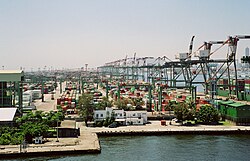

The Mergaveer Corporation, headquartered in Brugham, Mergany is a global freight shipping company. Its principal trading routes are the Eastern Uletha to Antarephia, the Eastern Uletha to Archanta and in the Darcodian Sea and Kaspen Sea. Mergaveer's shipping containers are painted green with the word "MERGAVEER" placed on the sides in white letters. Main harbour with service and maintenance facilities is the Port of Brugham. Other large hubs are Khaiwoon, Trevers, Merania and Norderhaven.


Fleet

Mergaveer currently operates about 190 ships, 161 of which are container ships with a total fleet capacity of 0.8 million PPE. Here is a list of the largest ones:
- MERG-J2-class, 3 ships, around 11000 PPE, built since 2016 by Holm&Voss
- MERG-J-class, 15 ships, around 9000 PPE, built since 2012 by Holm&Voss
- MERG-H-class, 11 ships, around 7500 PPE, built 2009-2012
- MERG-G-class, 33 ships, around 6150 PPE, built 2002-2009
- MERG-F-class, 28 ships, around 5050 PPE, built 1998-2002
- MERG-E-class, 29 ships, around 4250 PPE, built 1992-1998
- MERG-D-class, 16 ships, around 3500 PPE, built 1988-1992
- MERG-C-class, 8 ships, around 3100 PPE, built 1987-1988
- MERG-B-class, 10 ships, around 2100 PPE, built 1984-1986
- MERG-A3-class, 9 ships, around 1150 PPE, built 1983-1984 (6 in operation)
- MERG-A2-class, 17 ships, around 1050 PPE, built 1979-1983 (5 in operation)
- MERG-A-class, 3 ships, around 950 PPE, built 1978 (all are retired or sold)
- Colong's class, 7 ships, around 800 PPE, built 1974-1977 (all are retired or sold)
- Cooke's class, 12 ships, around 650 PPE, built 1969-1975 (all are retired or sold)
- Simi's class, 6 ships, around 370 PPE, built 1965-1971 (all are retired or sold)

Main ports
- Brugham
- Norderhaven
- Khaiwooon, Khaiwooon
- xxx, Latina
- Trevers, Paroy
Frequent shipping routes
- Khaiwoon---Brugham
- xxx---Brugham
- xxx---Brugham
- xxx---Brugham
- xxx---Brugham
- xxx---Brugham
- xxx---Brugham
Planeo
This section about Planeo is a blind text and will be expanded hopefully soon. Similar blind texts will be edited and expanded by the corresponding territory's owner. If you have any ideas about it, feel free to participate and edit this section.
This section is a blind text and will be expanded hopefully soon. Similar blind texts will be edited and expanded by the corresponding territory's owner. If you have any ideas about it, feel free to participate and edit this section. However, please respect other people's previous work – if you want to change already-developed ideas, contact the author. A stub is an article that, although sometimes providing more or less useful information, is too short to provide OGF encyclopedic coverage of a subject, and that is capable of expansion. Also non-article pages, such as disambiguation pages, lists, categories, templates, talk pages, and redirects, can be regarded as stubs. Due to the lack of time, some stub articles have little verifiable information, but its subject has an apparent notability. Stub articles and sections are very important to the life of a wiki. Adding a topic might inspire another community member to add to it, and eventually the topic has enough content to be valuable to the community. Stub pages help show the progressive nature of the wiki. Sizable articles are usually not considered stubs, even if they have significant problems or are noticeably incomplete. Over the years, different editors have followed different rules of thumb to help them decide when an article is likely to be a stub. Editors may decide that an article with more than ten sentences is too big to be a stub, or that the threshold for another article may be 250 words. Others follow other standards of e.g. 1500 characters in the main text. There is no set size at which an article stops being a stub.
Wātānābe Ärospás
Wātānābe Ärospás (SC)
Some details ...